Combining printed electronics and augmented reality to turn invisible thermal data into an interactive visual interface.
Thermal behavior is critical in many industrial systems - yet it remains largely invisible.
Today, engineers rely on indirect measurements, delayed feedback, or external tools such as thermal cameras to understand what is happening on a surface.
At NeoTronis, we are exploring a different paradigm : making thermal data directly visible, in real time, on the physical object itself.
A hybrid approach combining printed electronics and augmented reality
Our approach is based on the convergence of two technologies:
Printed electronics, enabling the integration of heating and sensing functions on flexible substrates
Augmented reality, enabling real-time visualization of thermal data directly on the surface
This combination creates a new type of interface where physical behavior and digital information are seamlessly merged.
Real-time thermal visualization, without external instrumentation
By leveraging this architecture, thermal distribution can be visualized:
Directly on the physical surface
In real time
Without the need for external measurement devices
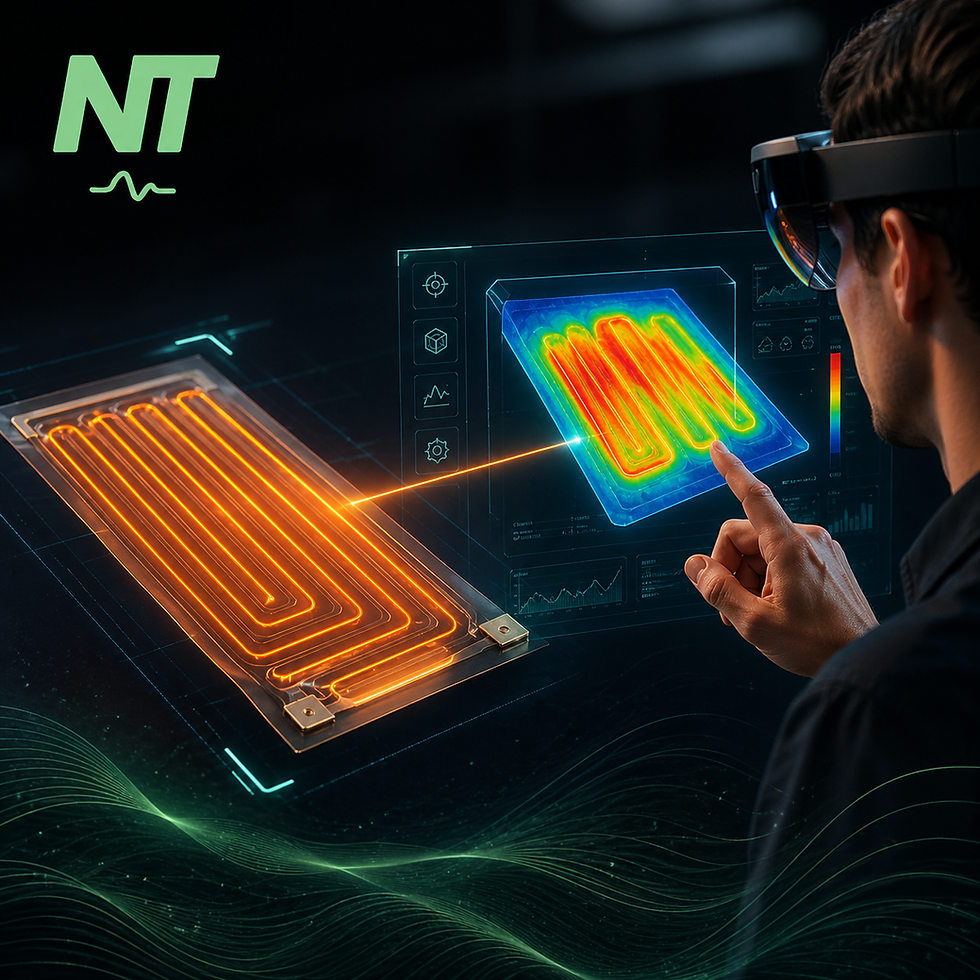
The result is a contextualized and intuitive representation of thermal phenomena, eliminating the need for indirect interpretation.
From data acquisition to actionable insight
In conventional systems, thermal data is often:
Acquired separately from the system
Processed with delay
Interpreted through external interfaces
With this approach, thermal data becomes:
Embedded within the system
Immediately accessible
Directly actionable
This shift enables faster analysis, better decision-making, and improved system understanding.
Industrial perspectives and use cases
This technology opens new possibilities across multiple domains:
Advanced human-machine interfaces (HMI)
Thermal diagnostics and monitoring
Predictive maintenance
Energy efficiency optimization
Safety and control of heating systems
More broadly, it contributes to the development of smart surfaces capable of communicating their physical state.
Toward a new generation of physical interfaces
By combining material engineering and digital visualization, we move beyond traditional interfaces.
The surface is no longer passive - it becomes an active layer of information.

This represents a key step toward more intuitive, responsive, and intelligent industrial systems.
Conclusion
Making heat visible in real time is not just a technological demonstration.
It reflects a broader evolution in how we design and interact with physical systems - where data is no longer separated from the object, but integrated into it.
At NeoTronis, we support industrial partners in exploring and deploying these new approaches, from concept to functional demonstrator.


Comments